Talk Data to Me?

Supporting English Language Learners in Statistics and Data Science

Liza Bolton

Waipapa Taumata Rau University of Auckland

Nathalie Moon

University of Toronto

Samantha-Jo Caetano

University of Toronto

J. Sparks

University of Guelph

Quin Xie

University of Toronto

Ping Huang

Waipapa Taumata Rau University of Auckland

Christy Sun

Waipapa Taumata Rau University of Auckland

Jingdi Sun

Waipapa Taumata Rau University of Auckland

Warm Pacific greetings

Talofa lavaSamoan, Malo e leleiTongan, Kia oranaCook Islands Māori, Mālo niTokelauan, Fakaalofa lahi atuNiuean, Ni sa bulaFijian, FakatalofaTuvaluan, Kia orate reo Māori.

QR code with ICOTS logo embedded

Acknowledgement of country

We acknowledge the Jagera and Turrbal peoples as the Traditional Custodians of Meanjin (Brisbane), the lands and waterways where we gather, learn, and share knowledge during ICOTS 12.

We pay our respects to their Elders past, present, and emerging, recognizing their enduring and continuous connection to land, water, and community.

Tangata whenua

The teaching and research that informs this presentation were conducted on the traditional lands of Māori under te Tiriti o Waitangi and of the Anishinaabe, the Haudenosaunee and the Mississaugas of the Credit under the Dish With One Spoon Treaty and, more recently, Treaty 13 between the Mississaugas and the British Crown.

Additional experiences at Southwest University, China, also informed this work.

Positionality statement

English is the first language I learned.

I have never had my personal success, safety, or access to resources rely on my abilities in another language.

Language is not just a skill — it is part of culture, identity, and how we know others and make ourselves known in turn.

Will this be useful to you?

Not a lot of ELLs? Should you sneak out now?

  • Connects to: Universal Design for Learning & trauma-informed pedagogy.
  • May pull financial levers in your institution that other lenses do not.

Will this be useful to any of us?

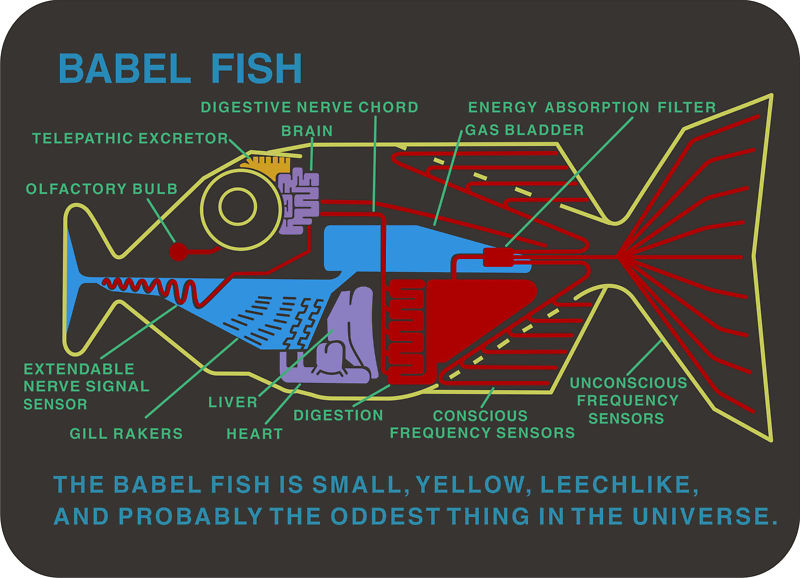
  • The elephant in the room? AI babel fish for all?
  • The importance of process: While AI and technological enhancements will change how we approach products, the human process will continue to matter.

Around the world in 80 years

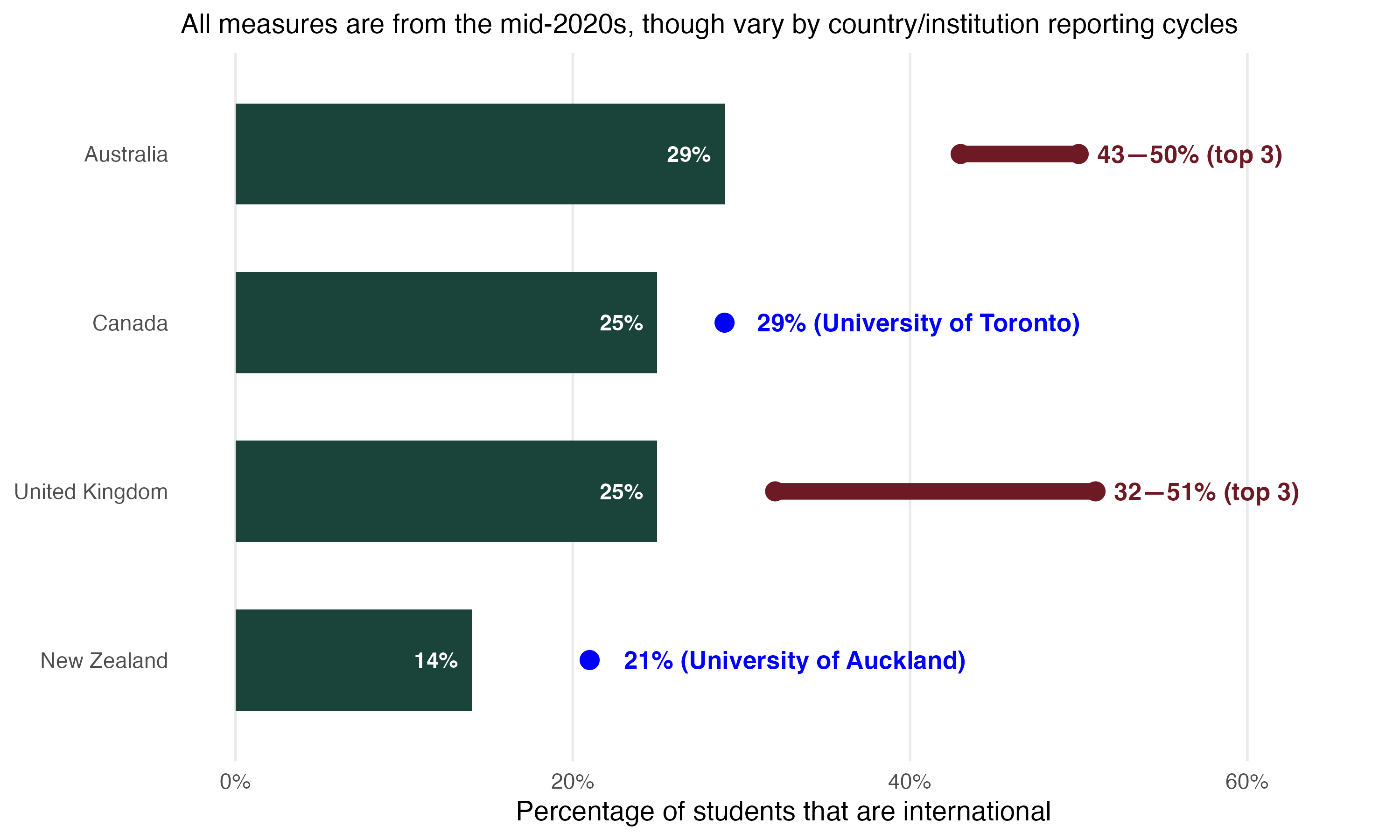
International student enrollments in universities

Australian Department of Education (2024),
Australian Department of Education (2025),
HESA (2024),
Ministry of Education (2026), Statistics Canada (2026),
QS Quacquarelli Symonds (2023),
Australian Department of Education (2024),
University of Auckland (2024),
University of Toronto (n.d.)

International ≠ ELL

English Language Learners (ELL): students who speak another language more fluently than they speak English AND need support to engage confidently in the standard English dialect of their educational environment.

A note on terms: ELL is used by the Ministry of Education in Aotearoa New Zealand Ministry of Education (2024). Other educational organisations advocate for “multilingual learners” (ESL/ELD Resource Group of Ontario 2022). In Australia the term “EAL/D” includes Aboriginal and Torres Strait Islander students who may speak Aboriginal English and Kriol (NSW Education Standards Authority 2026).

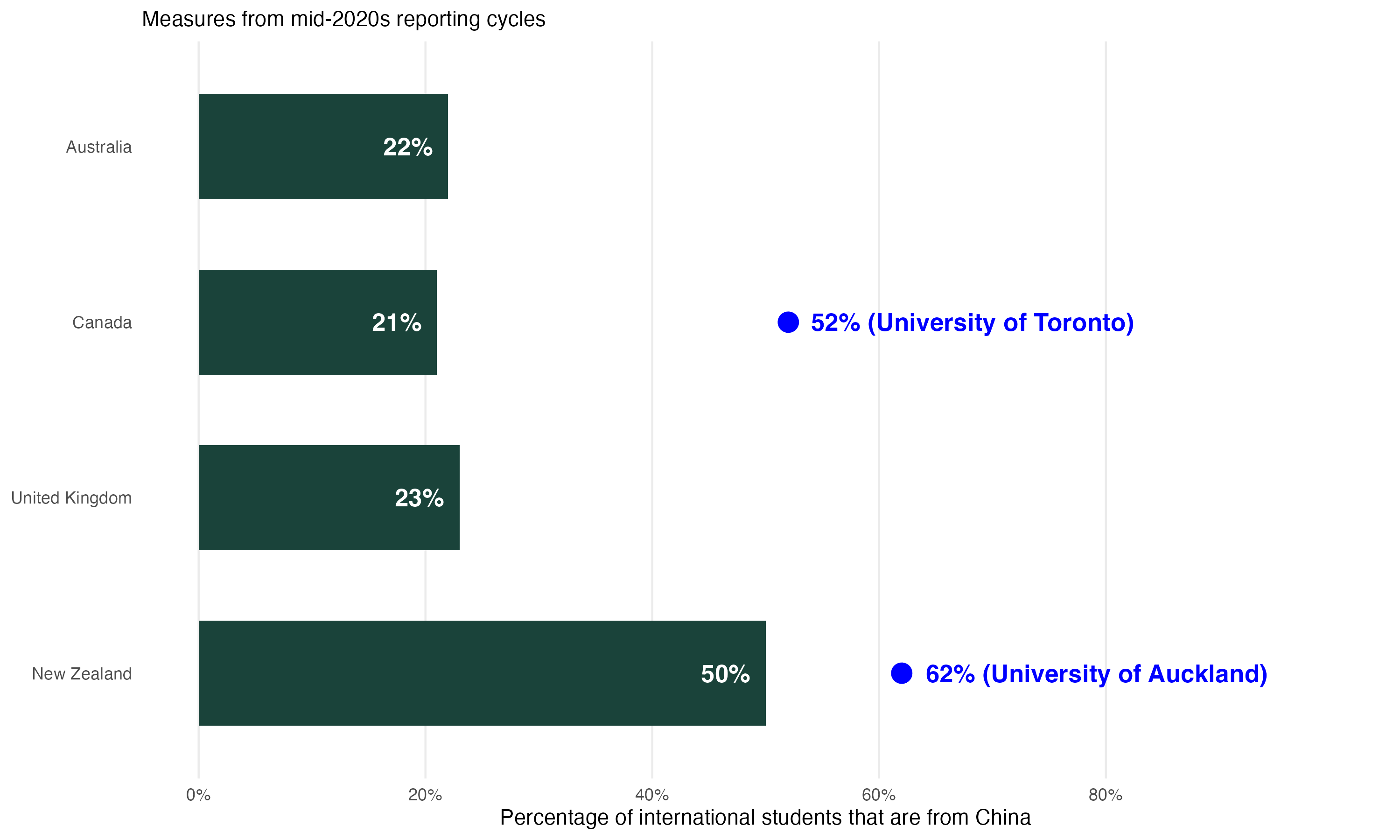
International students from China

Note: EU students not counted as international for UK calculation

Australian Department of Education (2024),
Education Counts (2024),
HESA (2024),
Statistics Canada (2026),
University of Auckland (2024),
University of Toronto (n.d.)

Three levels of strategies/ideas

Small: teaching practices

  • The power of pausing: Pausing 🧘‍♀️ > going slow 🐢 (Blau 1000; Hayati 2010; Lesser and Winsor 2009)
  • Speake AND write instructions/answers
  • Be explicit when navigating shared languages and translanguaging (Dovchin 2024)
    • Shared languages for encouragement
    • Language of instruction for help with assessments, concepts, etc.

Medium: assessment design

Big: design and institutional support

Examples

Practice example: Teaching undergrad data science in China

  • Students were reluctant to raise hands or answer questions in front of the whole class.
  • They weren’t all disengaged; they needed a sense of safety and the appropriate time and support to engage with the activities.
  • Modified “Think, Pair, Share”
    • Structure timing
    • Use anonymous writing submission tools
  • From NO raised hands to 50%-70% of the class submitting answers.

Survey study: Large intro stats and data science course at an English-medium university

  • This course was intentionally designed to incorporate recommended techniques for teaching and developing students’ written communication skills, alongside the introduction of statistical concepts and computing skills (Gibbs and Taback 2021).
  • Low student-to-teaching assistant ratio (24:1).
  • Significant collaboration with the university’s English Language Learning unit to support teaching assistant training and aid in the upskilling of instructors.
  • Four iterations of a large, first-year undergraduate introductory statistics and data science course at the University of Toronto.
    • Delivery: online between September 2020 and April 2022.
  • ELLs accounted for 76% to 83% of enrolments over the study period.
  • n=1,697 students participated in a pre- and post- survey.
  • The course design integrated frequent, low-stakes writing practice through weekly writing tasks and online discussion boards, culminating in a scaffolded group project that included a proposal, final report, and peer review.
  • Data were collected using pre- and post-course surveys in which students self-assessed their professional writing proficiency and identified the course components most beneficial to their development.
  • Improvements for all: The proportion of students rating their proficiency as Good or higher rose from 63% at the start of the semester to 78% by the end.
  • ELL gains: Of ELLs who began the course rating themselves as having Poor or Adequate proficiency (n = 572), 57% rated themselves as Good or above by the end of the course.
  • Effective components: Weekly writing tasks, online discussion boards, and the final project were rated as most beneficial for developing their writing skills.
  • We cannot assess the extent to which cross-cultural differences in survey and self-rating behaviours were present and/or evolved as students spent more time acclimatising to the institution.
  • In future work, variable response styles may be important to consider (Dolnicar and Grün 2007), potentially alongside links to assessment-based evaluation.

Takeaways 🥡

  1. No matter the resources you have, there are things you can do to make your course more accessible to ELL students. Small — Medium — Big.
  2. Doing better for ELLs can help us do better for a wide range of students.
  3. The current demographic reality of higher ed → some sort of arcane accounting/granting/budgeting magic → the resources to implement UDL/trauma-informed/relational pedagogies?

With gratitude to 💐

The many students, teaching assistants, and colleagues who have contributed to our understanding and the development of our teaching practices for supporting English Language Learners.

💰: Waipapa Taumata Rau | University of Auckland Faculty of Science Scholarship of Teaching and Learning Grant

Our ICOTS 12 conference proceedings reviewers — your thoughtful comments helped us improve this presentation and accompanying paper.

All those involved with making ICOTS happen. And thanks to the lads in the AV booth at the back!

Last, but certainly not least, thank YOU for being here.

Let’s talk!

liza.bolton@auckland.ac.nz

QR code with ICOTS logo embedded

About these slides:

  • All images have alt text.

  • You can translate these slides in your browser.

  • There are references on the following slides.

References (scrollable)

Alqurashi, Fahad. 2019. “Pragmatic Competence for L2 Learners: The Case of Maybe, Perhaps, and Possibly as Hedging Terms.” Theory and Practice in Language Studies 9 (6): 637–44. https://doi.org/10.17507/tpls.0906.05.
Altbach, Philip G., Liz Reisberg, and Laura E. Rumbley. 2009. Trends in Global Higher Education: Tracking an Academic Revolution. UNESCO.
Aspelin, Jonas. 2020. “Teaching as a Way of Bonding: A Contribution to the Relational Theory of Teaching.” Educational Philosophy and Theory 53 (6): 588–96. https://doi.org/10.1080/00131857.2020.1798758.
Australian Department of Education. 2024. “2024 Section 2: All Students.” Australian Government. https://www.education.gov.au/higher-education-statistics/resources/2024-section-2-all-students.
———. 2025. “International Student Numbers by Country, State and Territory.” Australian Government. https://www.education.gov.au/international-education-data-and-research/international-student-numbers-country-state-and-territory.
Blau, Eileen K. 1000. “The Effect of Syntax, Speed, and Pauses on Listening Comprehension.” TESOL Quarterly 24 (4): 746–53. https://doi.org/10.2307/3587129.
Carver, Robert, Michelle Everson, John Gabrosek, Nicholas Horton, Robin Lock, Megan Mocko, Allan Rossman, et al. 2016. Guidelines for Assessment and Instruction in Statistics Education (GAISE) College Report 2016. American Statistical Association. https://www.amstat.org/education/gaise/GaiseCollege_full.pdf.
Dolnicar, Sara, and Bettina Grün. 2007. “Cross-Cultural Differences in Survey Response Patterns.” International Marketing Review 24 (2): 127–43. https://doi.org/10.1108/02651330710741785.
Dovchin, Sender. 2024. “The Resistance to Translanguaging, Spontaneous Translanguagers and Native Speaker Saviorism.” Critical Inquiry in Language Studies.
Education Counts. 2024. “Tertiary Participation Rates.” New Zealand Ministry of Education. https://www.educationcounts.govt.nz/statistics/tertiary-participation.
ESL/ELD Resource Group of Ontario. 2022. “ERGO Position Statement on Multilingual Language Learners in Ontario Education, k-12.” Ontario: ESL/ELD Resource Group of Ontario.
Fergusson, Anna, and Maxine Pfannkuch. 2022. “Introducing Data Science Recipes in a Senior Secondary School Classroom.” Statistics Education Research Journal 21 (2): Article 7. https://doi.org/10.52041/serj.v21i2.49.
Franken, Margaret. 2023. “The New National Literacy Tests for Post-Primary Students in Aotearoa New Zealand: How Process and Design Issues Undermine Principles of a Strong and Fair Qualification.” Studies in Language Assessment 12 (2): 59–93.
Gibbs, Alison L., and Nathan Taback. 2021. “The Building Blocks of Statistical Education in the Data Science Ecosystem.” Harvard Data Science Review 3 (1). https://doi.org/10.1162/99608f92.180d1519.
Hayati, A. M. 2010. “The Effect of Speech Rate on Listening Comprehension of EFL Learners.” Creative Education 1 (2): 107–14. https://doi.org/10.4236/ce.2010.12016.
HESA. 2024. “Higher Education Student Statistics: UK, 2022/23.” Higher Education Statistics Agency.
Knight, Jane. 2004. “Internationalization Remodeled: Definition, Approaches, and Rationales.” Journal of Studies in International Education 8 (1): 5–31. https://doi.org/10.1177/1028315303260832.
Lesser, Lawrence M., and Matthew S. Winsor. 2009. “English Language Learners in Introductory Statistics: Lessons Learned from an Exploratory Case Study of Two Pre-Service Teachers.” Statistics Education Research Journal 8 (2): 5–32. https://doi.org/10.52041/serj.v8i2.393.
Marginson, Simon. 2016. “High Equity in a High-Fee System: The Remarkable Case of Australia.” Studies in Higher Education 41 (2): 267–84. https://doi.org/10.1080/03075079.2014.933464.
Ministry of Education. 2024. “Bilingual Assessment Service.” New Zealand Government. https://www.education.govt.nz/education-professionals/schools-year-0-13/learning-support/bilingual-assessment-service.
———. 2026. “Provider-Based Enrolments Dataset.” Education Counts, New Zealand Government. https://www.educationcounts.govt.nz/statistics/tertiary-participation.
NSW Education Standards Authority. 2026. “English as an Additional Language or Dialect (EAL/D) Support.” NSW Government, Education and Training. https://www.nsw.gov.au/education-and-training/nesa/diversity-of-learners/eald.
OECD. 2025. “What Are the Key Trends in International Student Mobility?” Education Indicators in Focus, no. 88. https://doi.org/10.1787/2a423a76-en.
QS Quacquarelli Symonds. 2023. “QS World University Rankings 2024: Top Global Universities.” https://www.topuniversities.com/world-university-rankings/2024.
Quinlan, K. M. 2022. “Relational Learning: Creating a Culture of Trust and Respect.” In Tapestry of Practice Symposium. University of Auckland, Auckland, New Zealand.
Statistics Canada. 2026. “Postsecondary Education.” Government of Canada. https://www150.statcan.gc.ca/n1/en/subjects/education_training_and_learning/postsecondary_education.
University of Auckland. 2024. “Annual Report 2024.” University of Auckland. https://www.auckland.ac.nz/en/about-us/about-the-university/the-university/official-publications/annual-report.html.
University of Toronto. n.d. “Facts and Figures: Students.” University of Toronto. https://data.utoronto.ca/data-and-reports/facts-and-figures/facts-and-figures-students/.
Whitaker, D. 2016. “Lexical Ambiguities in the Vocabulary of Statistics.” International Journal for Mathematics Teaching and Learning 17 (3): 1–14.
Wilkins, Stephen, and Jolanta Urbanovič. 2014. “English as the Lingua Franca in Transnational Higher Education: Motives and Prospects of Institutions That Teach in Languages Other Than English.” Journal of Studies in International Education 18 (5): 405–25. https://doi.org/10.1177/1028315313513239.
Wishnoff, J. R. 2000. “Hedging Your Bets: L2 Learners’ Acquisition of Pragmatic Devices in Academic Writing and Computer-Mediated Discourse.” Second Language Studies 19 (1): 127–57.

Icons

Talk Data to Me?

Get these slides: link.lizabolton.nz